
A late start is not always a punctuality problem. Time can also be lost finding the right remote, selecting an input or checking why the far end cannot hear. Clear controls and a tested setup can help users start with fewer interruptions.
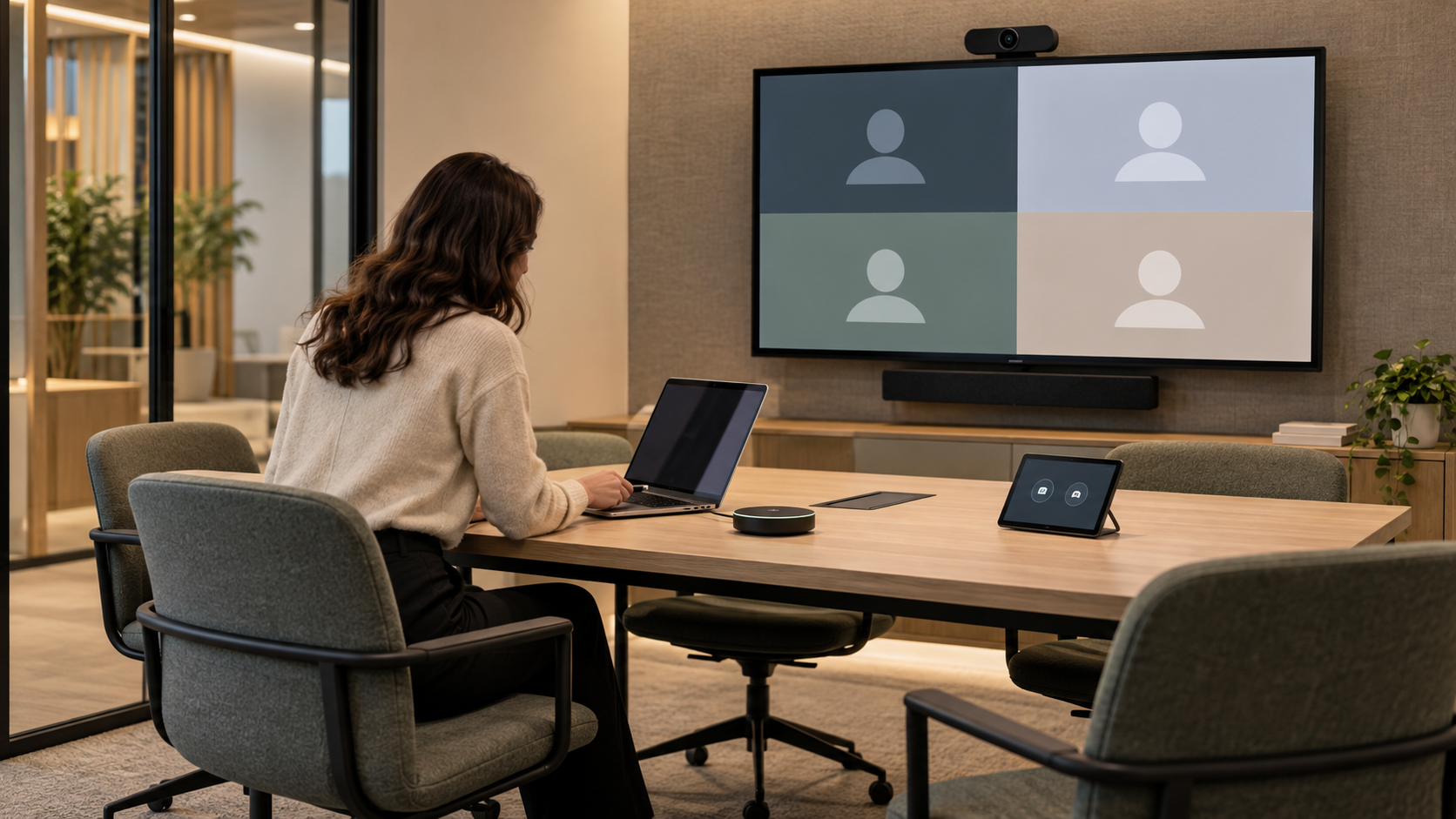
The first task in a meeting room should be starting the meeting. When users have to operate each component separately, the room is asking them to do its work.
Begin with a few real scenarios
Identify the situations your room needs to support. Write them down before choosing equipment:
- Present from my own laptop to people in the room.
- Join a scheduled video call on the business’s main platform.
- A guest presents from a device the business does not manage, possibly on a different platform.
Decide whether users will present from their own devices, use a fixed room system, or both. Include the conferencing platforms and guest situations the business genuinely needs. Adding connections “just in case” can make the interface harder to navigate.
Design the controls around actions
The interface should offer actions such as “Present” or “Join meeting”, not a list of devices and inputs. Use clear labels and make status visible:
- Which microphone is live, and whether it is muted.
- Whether the camera is on.
- Which screen is showing what.
There should also be one obvious way to end the session.
Test with people who were not involved
A technician’s polished demonstration proves the room can work. It does not prove that a new employee or a visitor can make it work. Ask people outside the project to start a representative meeting while you watch where they hesitate and what they expect to happen.
Illustrative scenario. Imagine a sales manager arriving with a client two minutes before a call. If she can walk in, tap “Join” and see the remote participants without needing technical help, the setup supports the intended workflow. If she needs assistance, record where she gets stuck and review the relevant controls or setup.
Plan the moment between meetings
Check what happens when a meeting ends: a guest’s device is disconnected, the room returns to its normal state, and the next user does not inherit the previous settings. Agree how the room behaves when a platform or connection is unavailable, and what help users can request.
Keep two kinds of documentation
- A short guide in the room, written in the same words as the controls.
- A detailed technical record for support.
Keep everyday controls separate from configuration settings, so a curious user cannot change the room for everyone. Any ongoing support arrangement should state which equipment and activities it covers.
Next step: Before accepting the interface and equipment, ask BootNet to demonstrate the proposed room through your most common meeting scenarios.
Related reading: Start the Network Brief With the Work, Not the Equipment. Contact BootNet to discuss your scope.